
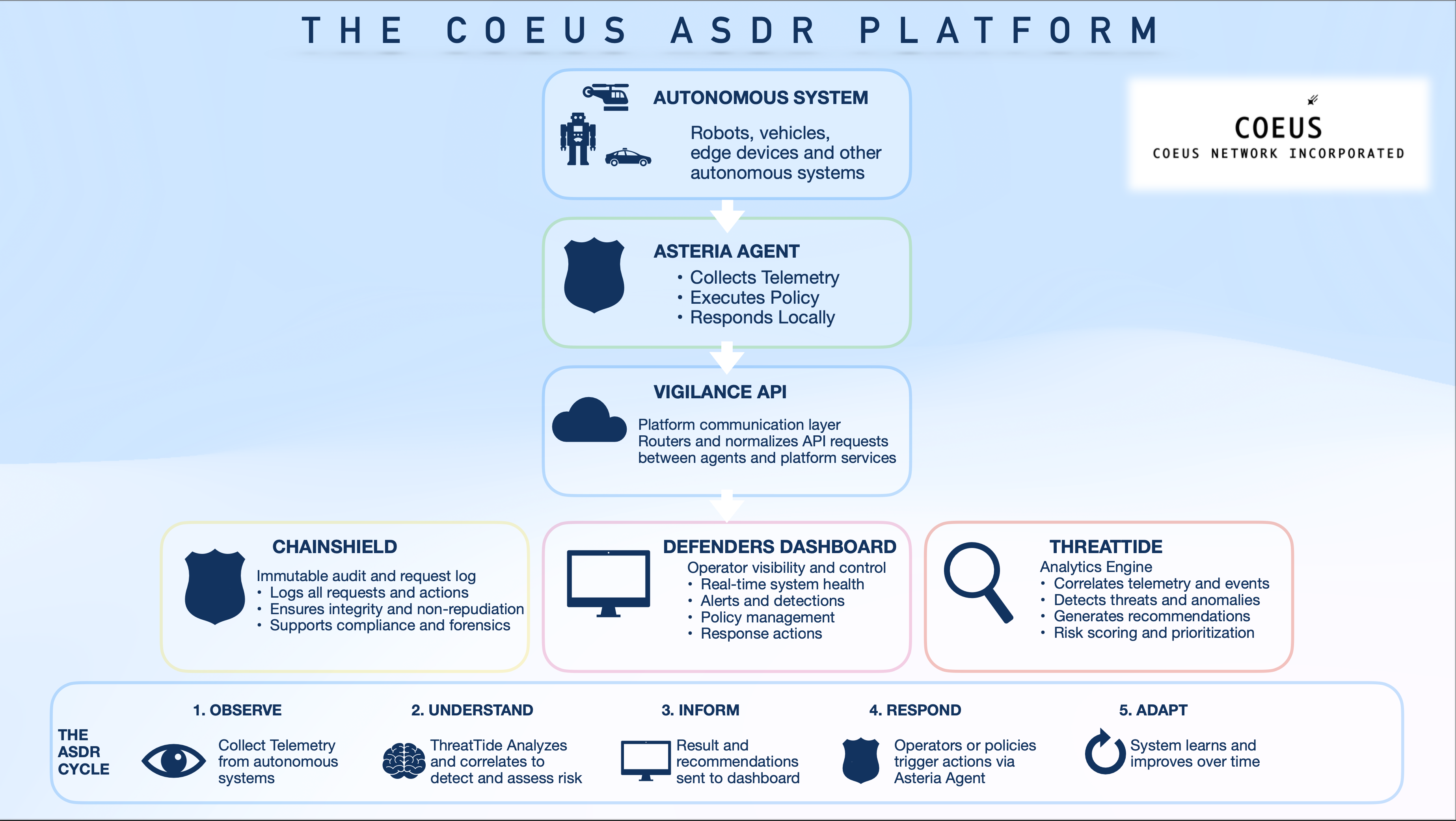
SEE IT. UNDERSTAND IT. TRUST IT. RESPOND IT. OPERATE IT.
Unlike conventional IT security focused on data confidentiality and integrity, ASDR operates in environments where latency, determinism, functional safety, and physical-world interactions are paramount. A compromised sensor feed or manipulated control loop is not merely a data breach — it can result in collisions, unintended movements, system failures, or harm to humans. ASDR ensures observability, trustworthiness, and resilience for edge devices, industrial robots, autonomous vehicles, drones, and advanced humanoids.
Built upon the Operational Risk Framework for Autonomous Systems (ORFAS), ASDR provides the operational Detect and Respond capabilities within a broader shared-responsibility model. It addresses the unique challenges of resource-constrained edge computing, non-deterministic AI behaviors, and the convergence of cybersecurity with functional safety standards such as ISO 26262, IEC 61508, and ISO 10218 for robotics.
Why ASDR Is Required
Modern autonomous systems integrate sophisticated AI models for perception and decision-making, sensor fusion pipelines, real-time middleware like ROS2, and low-latency actuation loops. These systems operate on edge hardware such as NVIDIA Jetson platforms, often in dynamic, unpredictable environments. This architecture creates a complex hybrid attack surface that spans digital, physical, and supply-chain domains.
Traditional security tools fall short for several critical reasons:
- Real-time constraints: Millisecond-level delays in detection or response can lead to physical incidents, violating safety requirements.
- Resource-constrained edge hardware: Limited CPU, GPU, memory, and power budgets prohibit heavy traditional security agents.
- Non-deterministic AI behavior: Stochastic models make it difficult to establish stable behavioral baselines.
- Physical-world consequences: Cyber compromises translate directly into safety risks, requiring tight integration with functional safety architectures.
- Fleet-scale complexity: Managing heterogeneous swarms or distributed deployments demands scalable, coordinated detection and response.
- Emerging threats: Sensor spoofing, adversarial machine learning attacks, firmware tampering, and supply-chain compromises are rising in sophistication.
ASDR bridges these gaps by embedding security natively into the autonomous stack, leveraging hardware roots of trust, lightweight edge agents, and intelligent cross-layer analytics.
ASDR within the ORFAS Model
ASDR is not a standalone tool but an operational implementation layer within the Operational Risk Framework for Autonomous Systems (ORFAS). ORFAS provides the overarching governance, risk modeling, and shared-responsibility structure, while ASDR delivers the real-time detection, response, and recovery capabilities.
The framework organizes controls across eight core pillars: Control Plane, Prevent, Detect, Respond, Recover, Attack Surface Management, Human-in-the-Loop Boundaries, and Supply Chain Provenance. Temporal models, cross-layer coupling, and safety/regulatory bindings ensure comprehensive risk management throughout the system lifecycle.
In this model, customers retain ownership of high-level governance (Control Plane and HITL), while ASDR platforms focus on continuous monitoring and execution within defined boundaries. This alignment enables "SEE IT. UNDERSTAND IT. TRUST IT. RESPOND IT. OPERATE IT." — turning observability into actionable resilience.
Core Components of ASDR
1. Control Plane
The Control Plane acts as the governance foundation. It defines operational policies, risk acceptance thresholds, zero-trust principles, system state machines (Normal → Degraded → Contained → Recovery), and kill-switch authority. This customer-owned layer ensures all ASDR actions remain aligned with safety certifications and organizational risk appetite.
2. Prevent Layer
Prevention establishes baseline trust before runtime. Key capabilities include secure boot chains, signed firmware and OTA updates, hardware roots of trust (e.g., TPMs like Infineon OPTIGA), device attestation, agent isolation, and dependency provenance verification. Technologies such as NVIDIA security features, Peridio, or Lynx secure environments form the foundation that ASDR assumes and monitors.
3. Detect Layer (Core of ASDR)
The Detect layer is the operational heart of ASDR. It provides continuous, multi-modal observability across all system layers to identify anomalies, threats, and drift in real time.
Detection methods include:
- Signature detection: Matching known indicators such as unauthorized USB enumeration, debug port activation, or malicious kernel modules.
- Anomaly detection: Machine learning models (autoencoders, isolation forests, time-series analysis) trained on sensor fusion data, syscall patterns, ROS2 message bus traffic, actuator feedback, and AI inference metrics.
- Cross-layer correlation: Linking firmware integrity checks with AI confidence scores, navigation consistency, and physical actuator responses to reduce false positives.
- IoC mapping: Tailored indicators including sensor desynchronization, unexpected position jumps, model embedding drift, resource anomalies, or unauthorized dependency changes.
Lightweight edge agents combined with fog/cloud analytics ensure low-latency detection while handling compute-intensive models. Advanced implementations incorporate adversarial intent modeling and observability gap detection.
4. Respond Layer
The Respond layer executes graduated containment under a shared responsibility model. Automated actions handle low-impact events (e.g., logging, sensor fallback), while high-impact decisions (e.g., full safe-stop or node isolation) require human-in-the-loop approval. Responses are deterministic, auditable, and designed to preserve safety invariants.
Typical actions include subsystem isolation, graceful degradation to redundant sensors, trust revocation, and entry into safe operational modes. Blast-radius modeling helps minimize operational disruption.
5. Recover Layer
Recovery focuses on rapid, verified restoration. Capabilities include forensic data preservation, guided rollbacks to attested trusted states, re-attestation of components, integrity validation, and post-incident analysis. The goal is minimal downtime with maximum confidence in restored system integrity.
6. Attack Surface Management
ASDR maintains a dynamic map of attack surfaces across physical interfaces (USB, sensors), OS/kernel, middleware (ROS2 DDS), application logic, network communications, AI models, and supply chain elements. Each surface entry includes risk scoring, specific IoCs, and detailed PDRR playbooks.
7. Temporal and Cross-Layer Risk Models
Advanced ASDR incorporates temporal dynamics such as trust decay over time, dependency propagation effects, and potential cascading failures. These models enable predictive risk assessment, proactive containment, and more accurate blast-radius estimation across fleets.
Implementation Methodology
Deploying ASDR follows a rigorous, risk-based lifecycle aligned with NIST Risk Management Framework (RMF) and ORFAS principles. This ensures systematic coverage from initial design through ongoing fleet operations.
Phase 1: System Mapping
Comprehensive inventory of all layers — hardware (SoCs, sensors, actuators), firmware, OS/kernel, middleware, AI pipelines, navigation/mission software, networks, and dependencies. Generate detailed Software Bills of Materials (SBOMs), map trust boundaries, and model data flows using digital twins where possible.
Phase 2: Threat Modeling
Apply CPS-specific methodologies (STRIDE adapted for physical interactions, PASTA) focusing on sensor spoofing, adversarial ML attacks, firmware tampering, and supply-chain risks. Prioritize scenarios with the highest safety impact.
Phase 3: Baseline and Instrumentation
Collect multi-modal telemetry under nominal, edge-case, and adversarial stress conditions. Deploy lightweight sensors: eBPF-style kernel probes, ROS2 introspection tools, hardware performance counters, TPM attestations, and AI-specific monitors.
Phase 4: Detection Engineering
Develop and tune anomaly detection models using unsupervised and supervised techniques. Implement cross-layer correlation engines and set confidence thresholds calibrated to safety requirements. Focus on low false-positive rates for production environments.
Phase 5: Response Orchestration
Define graduated playbooks with clear automation boundaries and HITL escalation paths. Ensure all responses are deterministic, logged with chain-of-custody, and aligned with functional safety constraints.
Phase 6: Validation and Testing
Conduct extensive red-team exercises using high-fidelity digital twins and physical testbeds. Measure key metrics: Mean Time to Detect (MTTD), Mean Time to Respond (MTTR), false positive/negative rates, and control effectiveness.
Phase 7: Fleet Operations
Roll out via phased canary deployments across heterogeneous fleets. Integrate with broader Security Operations Centers (SOCs) for centralized visibility while maintaining edge autonomy. Implement continuous monitoring, policy updates, and threat intelligence sharing.
ASDR in Autonomous Systems
ASDR adapts to the specific architectures of different autonomous platforms:
- Perception: Real-time monitoring for sensor spoofing, desynchronization, and adversarial inputs against vision, LiDAR, or radar models. Responses include sensor fallback or degraded autonomy modes.
- Control Systems: Detection of deviations in navigation, path planning, or decision logic through state machine validation and behavioral consistency checks.
- Actuation: Physical-digital reconciliation by comparing commanded vs. observed motion, torque feedback, and joint behavior in robots and humanoids.
- AI Models: Continuous integrity monitoring for model poisoning, extraction attacks, concept drift, and inference-time manipulation. Techniques include output confidence scoring and embedding analysis.
- Middleware: Specialized monitoring for ROS2 communication integrity, unauthorized publishers/subscribers, and message anomalies in distributed systems.
Security Operations Model
ASDR transforms traditional SecOps into Cyber-Physical Security Operations (CPSOps). Analysts gain rich context from fused telemetry across digital and physical domains, enabling faster triage and more informed decisions.
The shared responsibility model accelerates low-impact responses while preserving human oversight for safety-critical actions. Forensic capabilities support compliance and post-incident learning. Integration with Autonomous SOC platforms allows fleet-wide correlation and collective defense.
Challenges and Advanced Considerations
- Edge resource constraints: Balancing security overhead with real-time performance using hardware acceleration and efficient ML models.
- Explainability requirements: Providing auditable reasoning for detections to support safety certification processes.
- Self-protection: Defending the ASDR system itself against targeted attacks.
- Fleet-scale coordination: Managing collective anomalies in swarms while handling device heterogeneity.
- Regulatory alignment: Mapping to evolving standards including the EU AI Act, NIST AI RMF, and domain-specific cybersecurity regulations.
Future advancements include deeper digital twin integration for simulation-based validation, neuromorphic computing for efficient edge intelligence, quantum-resistant cryptography, and AI-driven collaborative threat intelligence across operator communities.
Conclusion
ASDR is a foundational discipline for the safe and secure deployment of autonomous systems. By extending cybersecurity principles into the physical world through the structured lens of ORFAS, organizations can achieve continuous observability, rapid response, and resilient recovery even under sophisticated adversarial conditions.
Implementing ASDR requires close collaboration between robotics engineers, security architects, AI specialists, and safety experts. The investment yields reduced risk of catastrophic failures, faster recovery times, regulatory compliance, and greater confidence in autonomous operations across manufacturing, logistics, healthcare, defense, and beyond.
Autonomous systems require security models that operate at the speed of the physical world.
As autonomy scales, frameworks like ASDR and ORFAS will become essential infrastructure for trustworthy intelligent machines.