
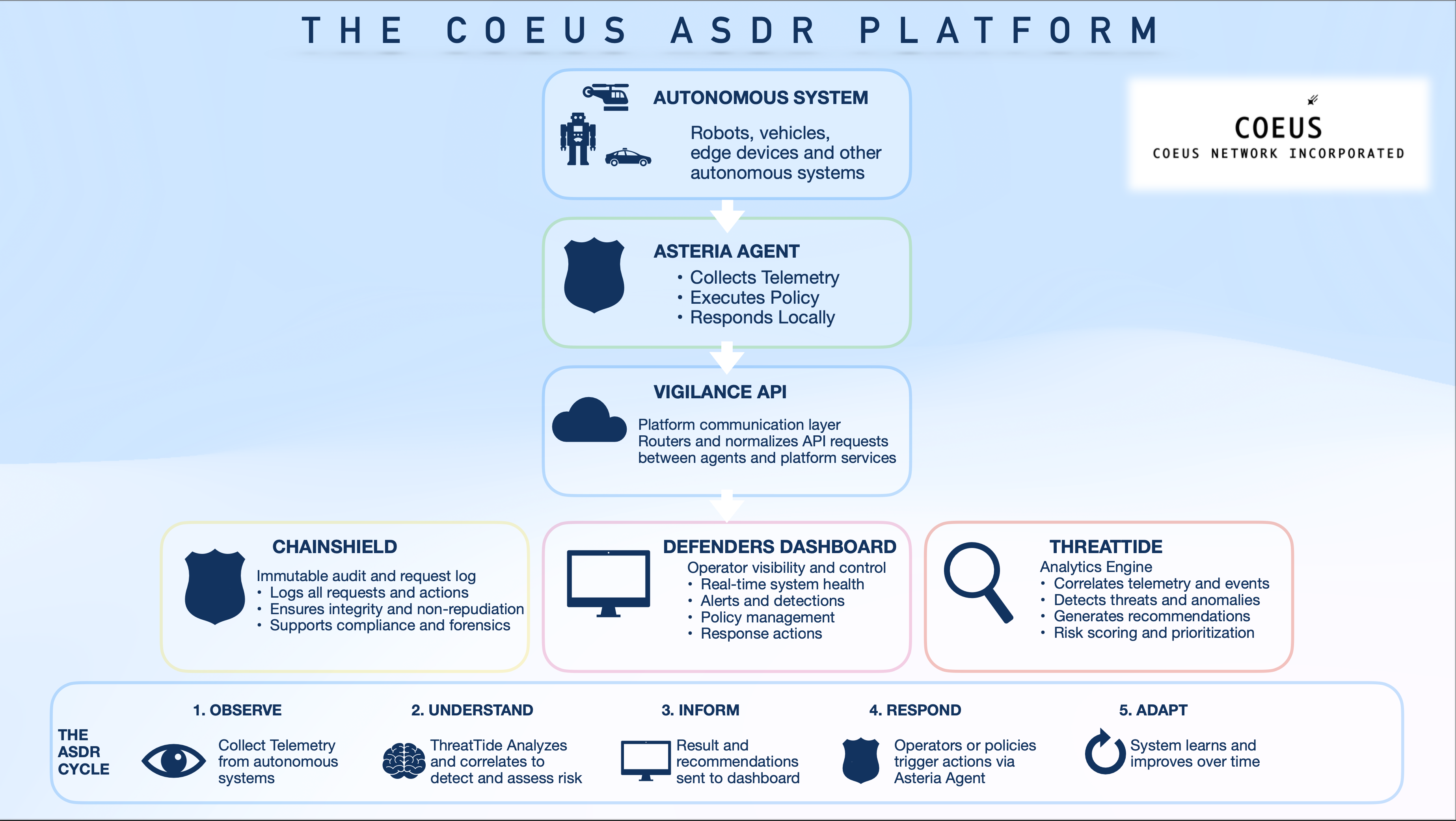
We are currently researching advanced ROS2 security methods. Based on our findings, the ROS2 DDS Security Mechanisms (DDS-Security + SROS2) the following serve as a good point of reference to guide us in implementing robust ROS2 detection and response capabilties into the Coeus Platform
Proper DDS security hardens one of the largest attack surfaces in ROS2-based robots and autonomous platforms, directly supporting the Detect, Respond, and Prevent layers of ASDR.
Why ROS2 DDS Security Matters
Unsecured ROS2 systems are highly vulnerable to discovery spoofing, topic injection, eavesdropping, and command hijacking. In autonomous systems, these can lead to physical consequences — from erratic robot behavior to full system compromise.
Key risks include:
- Unauthorized nodes joining the graph and publishing malicious commands
- Eavesdropping on sensitive sensor or control data
- Replay or tampering attacks on critical topics
- Lateral movement across fleet or multi-robot systems
DDS-Security + SROS2 addresses these by enforcing identity, authorization, and confidentiality at the middleware layer.
DDS-Security Specification Core Plugins
DDS-Security defines a pluggable architecture with five Service Plugin Interfaces (SPIs). ROS2 primarily leverages the first three:
1. Authentication Plugin (PKI-DH)
Uses X.509 certificates and Public Key Infrastructure. Each Domain participant (ROS2 node/process) presents a certificate signed by a trusted CA during discovery. This establishes verifiable identity.
2. Access Control Plugin
Enforces fine-grained permissions using two signed XML files:
- Governance file (governance.p7s): Domain-wide rules (e.g., encryption requirements, secured discovery)
- Permissions file: Participant-specific allowances (publish/subscribe to specific topics, QoS, etc.)
3. Cryptographic Plugin (AES-GCM-GMAC)
Provides authenticated encryption, key exchange, signing, and hashing. Once authentication and access control pass, all application data on protected topics is encrypted end-to-end.
SROS2: Making DDS-Security Usable in ROS2
SROS2 provides tools, libraries, and conventions to operationalize DDS-Security:
- Security Enclaves: Logical security boundaries that group nodes under shared identity and policies. An enclave is a directory containing the six required security artifacts (Identity CA, cert/key, Permissions CA, governance, permissions, and related files).
- ros2 security CLI: Automates keystore creation, CA generation, enclave provisioning, and policy management.
- Environment Variables & Configuration:
ROS_SECURITY_ENABLE=trueROS_SECURITY_STRATEGY=Enforce(vs. Permissive)- Enclave path specification
Enclaves allow flexible scoping — from per-node isolation to per-robot or per-subsystem grouping — enabling precise information flow control while managing key distribution complexity.
Implementation Methodology
Phase 1: Keystore and CA Setup
Use ros2 security create_keystore to initialize the root structure. Generate root and permissions CAs.
Phase 2: Enclave Creation and Policy Definition
Create enclaves for logical subsystems (e.g., perception, control, navigation). Define granular permissions for topics, services, and actions. Sign all policy files.
Phase 3: Integration and Testing
Launch nodes with security enabled. Test in Permissive mode first, then switch to Enforce. Validate with tools like ros2 security and network monitoring.
Phase 4: Deployment and Monitoring
Distribute keystores securely (e.g., via TPM-backed storage). Integrate with ASDR Detect layer for monitoring certificate validation failures, permission violations, and anomalous discovery traffic.
Integration with ASDR and ORFAS
ROS2 DDS Security is a critical Prevent and Detect control in the ORFAS model:
- Prevent Layer: Enclaves, governance, and encryption reduce attack surface.
- Detect Layer: Monitor for authentication failures, unauthorized discovery, or policy violations as high-fidelity IoCs.
- Respond Layer: Revoke certificates or isolate compromised enclaves automatically or via HITL.
- Attack Surface Management: DDS topics, discovery endpoints, and middleware become explicitly mapped and hardened.
Best Practices for Production Autonomous Systems
- Use minimal-privilege enclaves and isolate safety-critical subsystems
- Combine with network segmentation, secure boot, and hardware roots of trust
- Implement regular key rotation and certificate lifecycle management
- Monitor middleware telemetry as part of ASDR behavioral analytics
- Test with red-team scenarios including discovery spoofing and enclave bypass attempts
- Consider performance trade-offs — hardware acceleration (e.g., AES-NI, TrustZone) helps on edge devices
Challenges and Limitations
- Key and certificate management overhead in large fleets
- Performance impact on latency-sensitive control loops
- Configuration complexity leading to misconfigurations
- Legacy compatibility and mixed secure/unsecure graphs
- Ongoing discovery of implementation-specific vulnerabilities in DDS vendors
Advanced deployments address these through centralized policy management, digital twin validation, and integration with broader CPS security platforms.
Conclusion
Robust ROS2 DDS Security via SROS2 and DDS-Security is foundational for trustworthy autonomous systems. It transforms the middleware layer from a major vulnerability into a hardened, observable component that directly supports ASDR detection/response and ORFAS risk management.
Organizations building or deploying robots, humanoids, and edge autonomous platforms should treat SROS2 configuration as a non-negotiable part of their security baseline.
In autonomous systems, secure communication is not optional — it is a safety requirement.