
What This System Improves
Most autonomous systems fail in ways that are not immediately visible at the hardware or software level. These failures usually appear as delayed system behavior, unclear fault origins, or inconsistent performance across edge environments.
Examples of the problems this platform is designed to surface:
- Robotic systems that degrade without clear hardware failure
- Edge devices that behave differently under identical workloads
- Autonomous agents producing inconsistent decisions under state drift
- Distributed systems where failures propagate without clear origin points
- The Platform Overview
In most cases, these issues are not detected by traditional monitoring tools until they become operational incidents.
The Coeus Platform Beta is designed to surface these failure modes earlier through structured observation and behavioral comparison.
Overview
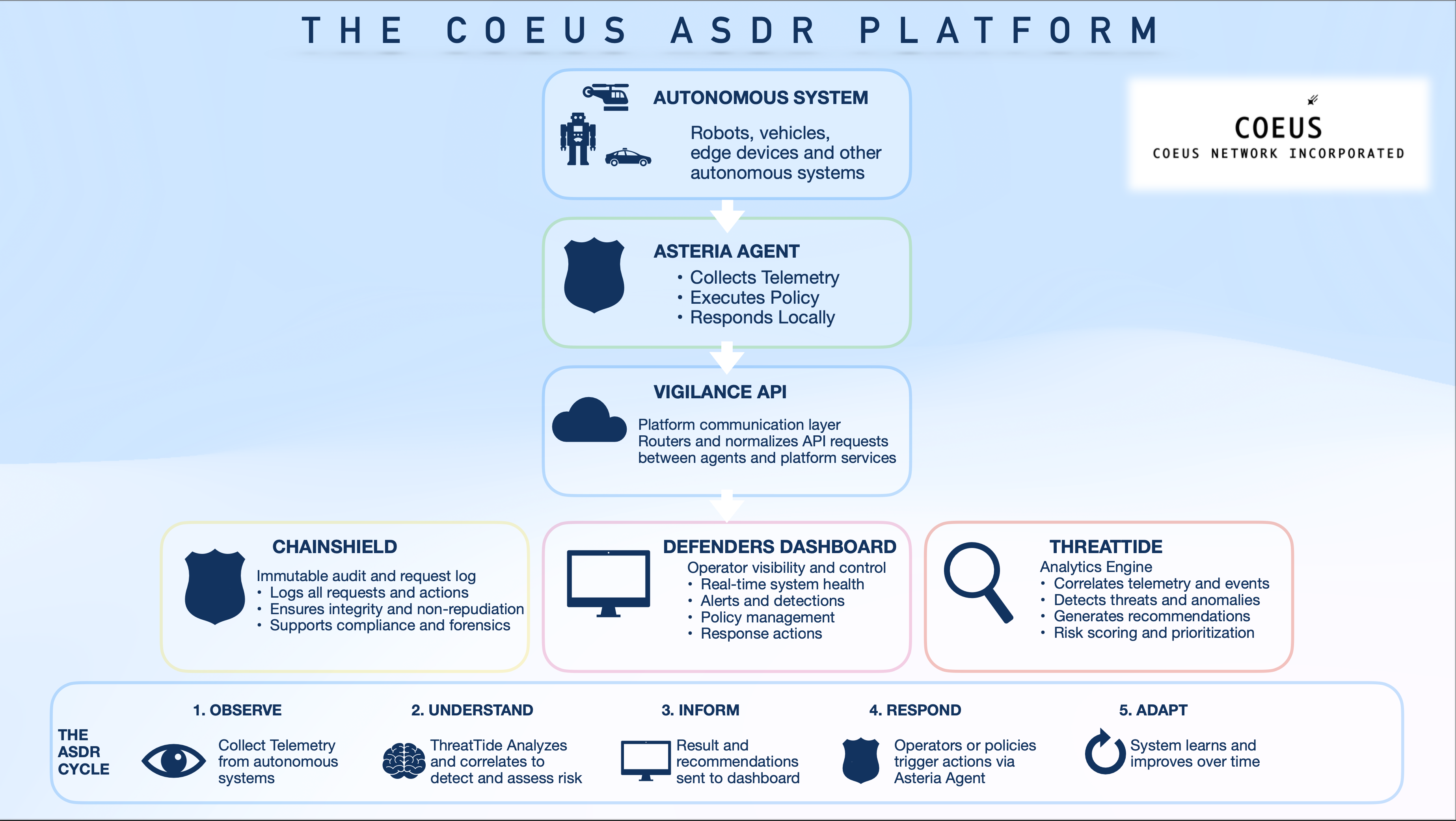
The Coeus Platform Beta is a controlled validation environment designed to evaluate real-world system behavior across edge devices, autonomous systems, and robotics infrastructure. It enables structured testing of telemetry pipelines, anomaly detection models, and response readiness under ORFAS aligned observability principles.
Required hardware for beta participation is an NVIDIA Jetson edge computing device (Nano, Xavier, or Orin family), used as the reference deployment environment for Asteria agent execution and telemetry capture.
Participants operate within a staged environment using the Asteria agent to collect system signals and validate behavioral consistency across devices and workloads.
This is a live operational environment for observation, not simulation.
Access and Enrollment
Engineers, security researchers, and robotics developers can enroll via defendersdashboard.com during the last week of July. After account creation, users configure their environment and deploy the Asteria agent.
- Create and verify Defenders Dashboard account
- Configure system or device environment
- Install Asteria agent
- Initialize telemetry ingestion pipeline
Phase 1: Telemetry Collection
Duration: 1–2 weeks (first half of August 2026, subject to change)
Phase 1 focuses strictly on passive data collection. No anomaly detection or system interpretation is applied during this stage.
Captured Signals
- CPU utilization and system load
- RAM usage patterns
- Battery consumption and power behavior
- Thermal metrics and hardware stress signals
- API logs and system event logs
- General system health indicators
No interpretation. No classification. Raw telemetry only.
Phase 2: Anomaly Detection (Passive Mode)
Duration: 1–2 weeks (second half of August 2026, subject to change)
Phase 2 introduces baseline modeling and drift detection while maintaining a strictly passive stance. The system observes behavior without taking automated action.
Detection Scope
- Baseline behavioral comparison across systems
- Drift detection in performance and telemetry signals
- Temporal anomaly pattern recognition
- Cross-signal correlation (non-actionable alerts)
Alerts only. No response execution. No system intervention.
Engineering Workflow
The beta environment integrates directly into existing engineering workflows through the Asteria agent, enabling structured observability without disrupting system operations.
All telemetry flows into Coeus Platform observability pipelines aligned with ORFAS detection standards.
Deployment Workflow
The following workflow demonstrates standard deployment, execution, monitoring, and teardown of the Asteria agent within the beta environment.
            # =========================
            # DEPLOYMENT (subject to change)
            # =========================

            # Copy agent to device
            scp -r ./asteria-agent user@device-ip:/opt/asteria

            # SSH into device
            ssh user@device-ip

            # Navigate to install directory
            cd /opt/asteria

            # Make scripts executable
            chmod +x asteria

            # Install and start agent
            ./asteria


            # =========================
            # MONITORING
            # =========================

            # View live logs
            tail -f /var/log/asteria.log

            # Check running process
            ps aux | grep asteria


            # =========================
            # TEARDOWN / CLEANUP
            # =========================

            # Stop running agent process
            pkill -f asteria

            # Stop system service (if enabled)
            systemctl stop asteria.service

            # Disable service
            systemctl disable asteria.service

            # Remove service file
            rm /etc/systemd/system/asteria.service

            # Reload system daemon
            systemctl daemon-reload

            # Remove installed agent
            rm -rf /opt/asteria
Feedback Loop
All participant activity feeds into iterative improvement of telemetry interpretation, anomaly detection sensitivity, and system-level behavioral baselines.
This feedback loop strengthens model precision, reduces false positives, and improves cross-layer correlation across autonomous environments.
Closing Statement
The Coeus Platform Beta marks the transition from framework definition to operational validation. It enables real-world testing of detection and response behavior across autonomous systems under controlled conditions.
Observe. Measure. Validate. Improve.